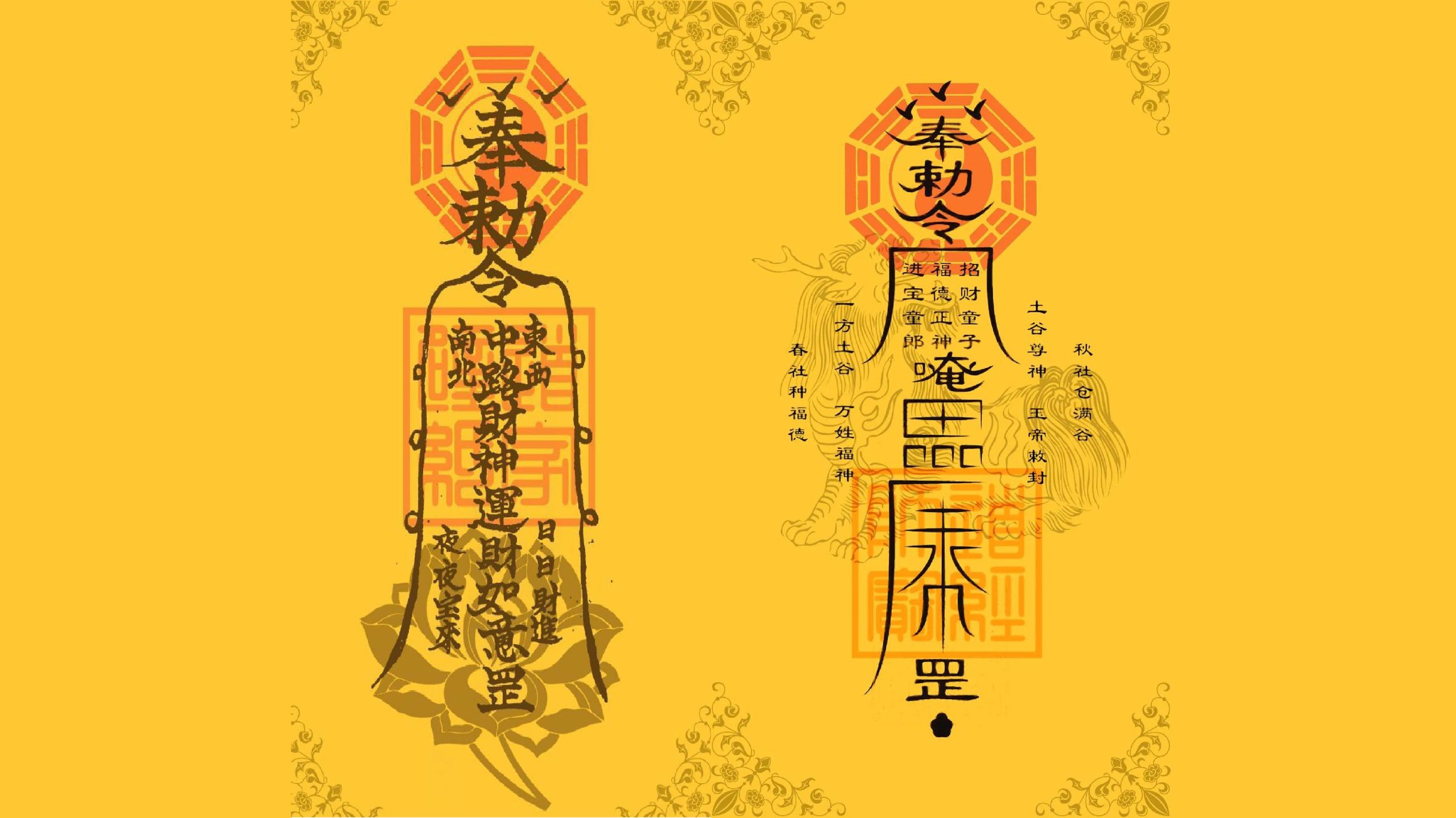
In Chinese Taoist culture, talismanic writing and sacred diagrams, known collectively as Fu Lu (符箓), form a unique system of religious symbols, written characters, and ritual practices. Taoist talismans are not simply decorative drawings. Their forms, inscriptions, symbols, and methods of writing are traditionally connected with the Taoist pantheon, ritual ceremonies, sacred formulas, and specific methods of ritual transmission.
The Chinese character “Fu” (符) generally refers to specially written or drawn symbols, characters, and diagrams that carry particular religious meanings. A talisman may be associated with a specific deity, ritual, incantation, or method of invocation. Therefore, its significance extends far beyond the appearance of the symbol itself.
Depending on their religious purpose and ritual context, Taoist talismans can be broadly divided into several major categories.
1. Talismans for Protection and Personal Safety
These talismans are primarily used to protect individuals and are among the most widely known forms of Taoist talismans. They may be carried on the person, placed in a personal space, or used as part of a religious ritual.
Personal Protection and Peace Talismans
These are traditionally believed to protect the wearer from harmful or negative influences and to safeguard personal well-being. Some may incorporate symbols associated with the Big Dipper, Tiangang (Heavenly Dipper), or the deities and stars associated with one’s birth year or destiny.
Tai Sui Talismans
Tai Sui talismans are traditionally associated with the annual Tai Sui deity and are used in rituals concerning one’s relationship with the Tai Sui of a particular year. They are commonly connected with traditional beliefs surrounding offending Tai Sui (fan Tai Sui), including being in conflict with, or directly opposing, the Tai Sui of the year.
Jie’e or Calamity-Relief Talismans
These talismans are traditionally used in rituals intended to remove obstacles, resolve misfortune, and alleviate various forms of difficulty or perceived spiritual affliction.
Big Dipper Longevity Talismans
Associated with Big Dipper worship and Dipper Offering rituals (Bai Dou), these talismans are traditionally used in prayers for longevity, protection, and spiritual stability.
2. Talismans for the Home and Physical Environment
These talismans are concerned with the protection and ritual purification of physical spaces, particularly homes, buildings, and places of residence.
They may be placed on doors, door frames, beams, walls, or other important locations within a building. In traditional practice, they may also be used together with door deities, guardian generals, and other protective rituals.
Eight Trigrams House-Protection Talismans
Associated with the Bagua (Eight Trigrams), these talismans are traditionally used to protect a residence, ward off harmful influences, and maintain harmony within the household.
Five Sacred Mountains Talismans
The Five Sacred Mountains (Wuyue) have an important place in traditional Chinese religious culture. Talismans incorporating their sacred forms or names may be used in rituals for protection, stability, and the ritual safeguarding of a place.
Earth-Settlement and Dragon-Protection Talismans
Traditionally used during activities such as construction, groundbreaking, moving into a new home, or establishing a new residence, these talismans are associated with rituals honoring the Earth deity and local spiritual forces.
Mountain-Sea Protection Talismans
Often associated with the traditional Shan Hai Zhen concept, these talismans may be used to symbolically address unfavorable external features or environmental influences affecting a residence.
3. Talismans for Wishes, Blessings, and Personal Goals
This category is closely connected with people’s everyday hopes and aspirations. Such talismans are traditionally used in prayers for success, prosperity, education, relationships, and good fortune.
They also reflect traditional Chinese ideas surrounding blessings, longevity, prosperity, and auspiciousness, and may sometimes be associated with seasonal festivals and folk customs.
Wenchang Talismans
Associated with Wenchang, the deity traditionally connected with literature and scholarly achievement, these talismans are used in traditional religious practices seeking wisdom, academic success, and progress in one’s studies.
Wealth and Business Talismans
These talismans are traditionally associated with prayers for financial prosperity, successful business, and commercial fortune. They may be used by merchants or business owners as part of traditional religious practices.
Hehe or Harmony Talismans
Hehe talismans are traditionally associated with harmony and reconciliation. They may be used in prayers concerning interpersonal relationships, marriage, family harmony, or the resolution of conflicts.
4. Talismans for Exorcism, Ritual Healing, and the Removal of Harmful Influences
This category includes talismans traditionally used to ward off evil influences, dispel ritual impurity, and address perceived spiritual disturbances.
Many talismans associated with Taoist Thunder Rites (Leifa) belong to this broad category.
Within traditional Taoist religious thought, the universe is understood as being inhabited by different levels of deities, spirits, and other spiritual forces. When a person or place is believed to be affected by an unfavorable spiritual influence, a Taoist priest may perform rituals involving talismans, incantations, ritual movements, and other ceremonial techniques.
It is therefore important to understand that a Taoist talisman is traditionally not regarded as an isolated piece of paper with magical power. Its religious function is generally understood within the context of a larger ritual system.
Five Thunder Talismans
Five Thunder talismans (Wulei Fu) are among the important talismanic forms associated with Taoist Thunder Rites. Traditionally, they are connected with the authority of the Thunder Department and are used in rituals intended to suppress harmful influences, dispel impurity, and avert calamities.
Thunder-related talismans are particularly prominent in traditions associated with Zhengyi Taoism and certain Thunder Rite traditions.
Heavenly Physician Talismans
Traditionally associated with prayers for healing, health, and spiritual reassurance, these talismans were used within religious healing practices in historical Taoist traditions.
It is important to distinguish such traditional religious practices from modern medical treatment.
Fright-Relief and Soul-Calming Talismans
These talismans are traditionally associated with calming the spirit and restoring a sense of spiritual balance. They may appear in rituals concerning nightmares, fright, emotional disturbance, or the traditional concept of an unsettled soul.
5. Talismans Used in Funerary and Salvation Rituals
This category is primarily associated with Taoist funerary rites, memorial ceremonies, and rituals for the salvation of the deceased.
Unlike protective talismans intended for everyday use, these talismans generally belong to specific religious ceremonies and are not normally intended to be carried by ordinary people as personal protective charms.
Talismans for the Salvation of the Deceased
These are traditionally used within Taoist salvation rituals to pray for the deceased and assist them in passing from the realm of suffering toward spiritual salvation.
Prison-Breaking and Blood-Lake Talismans
Prison-breaking (Po Yu) and Blood-Lake (Po Xuehu) talismans are associated with larger Taoist salvation rituals concerning the purification and liberation of souls in the underworld.
These concepts belong to the traditional Taoist religious imagination and should be understood within the context of its elaborate cosmology of the afterlife.
Soul-Calling Talismans
Soul-calling talismans may be used within certain ritual ceremonies to summon or invite the spirit of the deceased to the ritual altar, where offerings and prayers can be performed on its behalf.
Taoist Talismans by Their Writing Materials
Taoist talismans can also be classified according to the material on which they are written or inscribed.
1. Paper Talismans
Paper talismans are perhaps the most familiar form. Traditionally, yellow paper and cinnabar-red ink (zhusha) are among the most recognizable combinations.
Other colors of paper, including red, green, or black, may appear in particular ritual contexts, although their use varies according to different Taoist traditions and ritual systems.
2. Cloth and Silk Talismans
Some talismans are written or painted on cloth or silk. Because of their greater durability, these may be suitable for long-term display, hanging, or ceremonial use.
3. Stone, Wood, and Metal Talismans
Talismanic inscriptions and sacred designs may also be carved into stone, wood, or metal, allowing them to remain in place for a long period of time.
Examples include protective objects associated with Shigandang (stone guardians) and representations of the Five Sacred Mountains carved into wooden or other durable ritual objects.
4. Cinnabar and Ink Talismans
The materials used to write a talisman can also carry symbolic significance.
Cinnabar (zhusha), a traditional red mineral pigment, is strongly associated with Taoist ritual writing and is especially recognizable in protective and exorcistic talismans.
Soot-based ink, traditionally made from materials such as pine soot, may also be used in Taoist writing and ritual documents, including certain forms of memorials, petitions, and talismanic texts.
The choice of writing material, ink, color, and format can vary considerably between Taoist schools and individual ritual traditions.
Taoist talismans are much more than mysterious symbols drawn on paper. They represent a complex religious system combining written characters, sacred symbols, cosmology, deities, ritual language, and ceremonial practice.
Different talismans serve different purposes: some are associated with personal protection, some with the safeguarding of homes and buildings, some with prayers for prosperity or academic success, while others belong exclusively to healing, exorcistic, funerary, or salvation rituals.
It is also important to remember that there is no single universal system of Taoist talismans. Their forms, names, meanings, and methods of use can vary between different Taoist schools, historical periods, and ritual lineages.
For this reason, understanding a Taoist talisman requires looking beyond its visual appearance and considering the religious tradition, ritual context, deity, text, and method of transmission behind it.