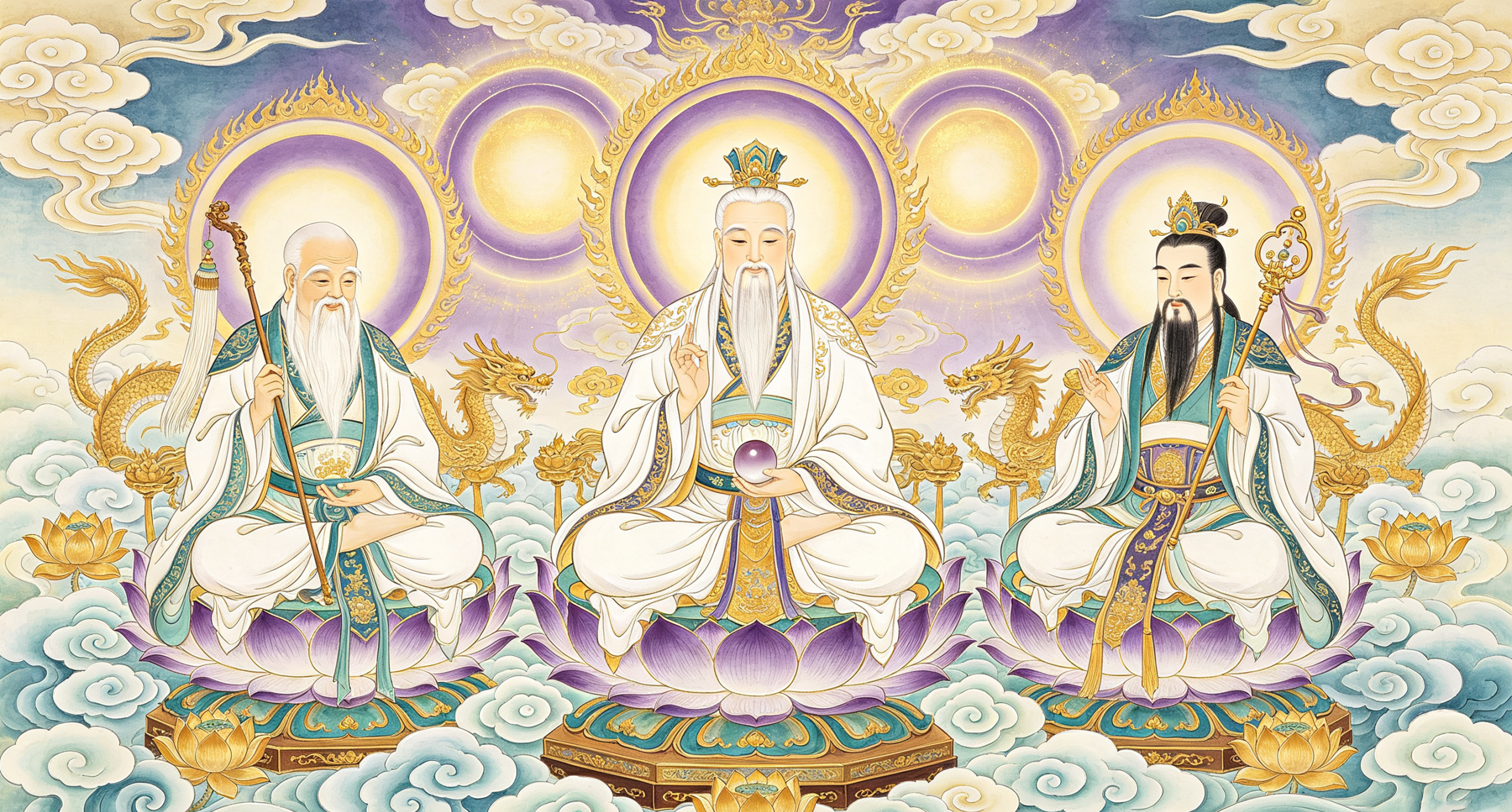
The fundamental belief of Taoism is “the Tao” (Dao). Taoist practitioners regard learning the Tao, cultivating the Tao, and following the Tao as the essence of their spiritual practice, which is why the tradition is called Taoism. The Tao Te Ching (also known as The Book of Laozi), attributed to Laozi, is regarded as one of the most important Taoist scriptures.
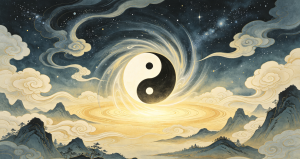
According to Taoist texts, the Tao is described as “the source of emptiness, the foundation of creation, the origin of divine existence, and the root of heaven and earth.” It is believed that all things in the universe arise from the Tao, and that the natural order of the cosmos—including yin and yang, the five elements, and all forms of life—are generated through its transformative power.
In the Taoist worldview, the human world is only one part of a much larger cosmic realm. Beyond the mortal world exist sacred realms where immortals dwell, including the Ten Great Grotto Heavens, Thirty-Six Lesser Grotto Heavens, and Seventy-Two Blessed Lands, which are regarded as spiritual paradises for enlightened beings.
Taoism teaches that the Tao transforms into three forms of primordial energy (qi), which give rise to the Three Pure Ones, the highest deities in the Taoist tradition: Yuanshi Tianzun (the Heavenly Venerable of Primordial Beginning), Lingbao Tianzun (the Heavenly Venerable of Numinous Treasure), and Daode Tianzun (the Heavenly Venerable of the Tao and Virtue, also identified with Laozi).
Taoism has developed a vast and complex pantheon of deities. In addition to the Three Pure Ones, Taoists also venerate many other divine beings, including the Jade Emperor, the Four Imperial Deities, the Five Heavenly Emperors, Doumu Yuanjun (the Mother Goddess of the Big Dipper), the Three Officials (Heaven, Earth, and Water), the Celestial Generals, the Thirty-Six Heavenly Generals, the Seventy-Two Earthly Spirits, Zhenwu Dadi (the Great Emperor Zhenwu), Dongyue Dadi (the Great Emperor of Mount Tai), Bixia Yuanjun, Guan Sheng Dijun (Guan Yu as a deified figure), City Gods, Earth Gods, the Kitchen God, and Door Gods, among many others.
Another essential aspect of Taoist belief is that the Tao embodies eternal life and vitality. To attain and preserve the qualities of the Tao is known as cultivating “De” (virtue or inner attainment). In Taoist thought, De also means “to obtain” or “to realize”—meaning that by attaining the Tao, one can achieve spiritual fulfillment. Through Taoist cultivation, humans may transcend ordinary existence, attain longevity, and ultimately become immortals.
Taoism places great emphasis on respecting and nurturing life. It values life, pursues longevity, and encourages practitioners to seek the true nature of existence through learning, cultivating, and embodying the Tao. Through spiritual practices, one strives to achieve the state of “unity between life and the Tao”, returning to one’s original nature, restoring harmony with the universe, and becoming one with the Tao. This ultimate state is often described as returning to the purity and simplicity of an infant, attaining eternal existence, and dwelling in the realm of immortals.