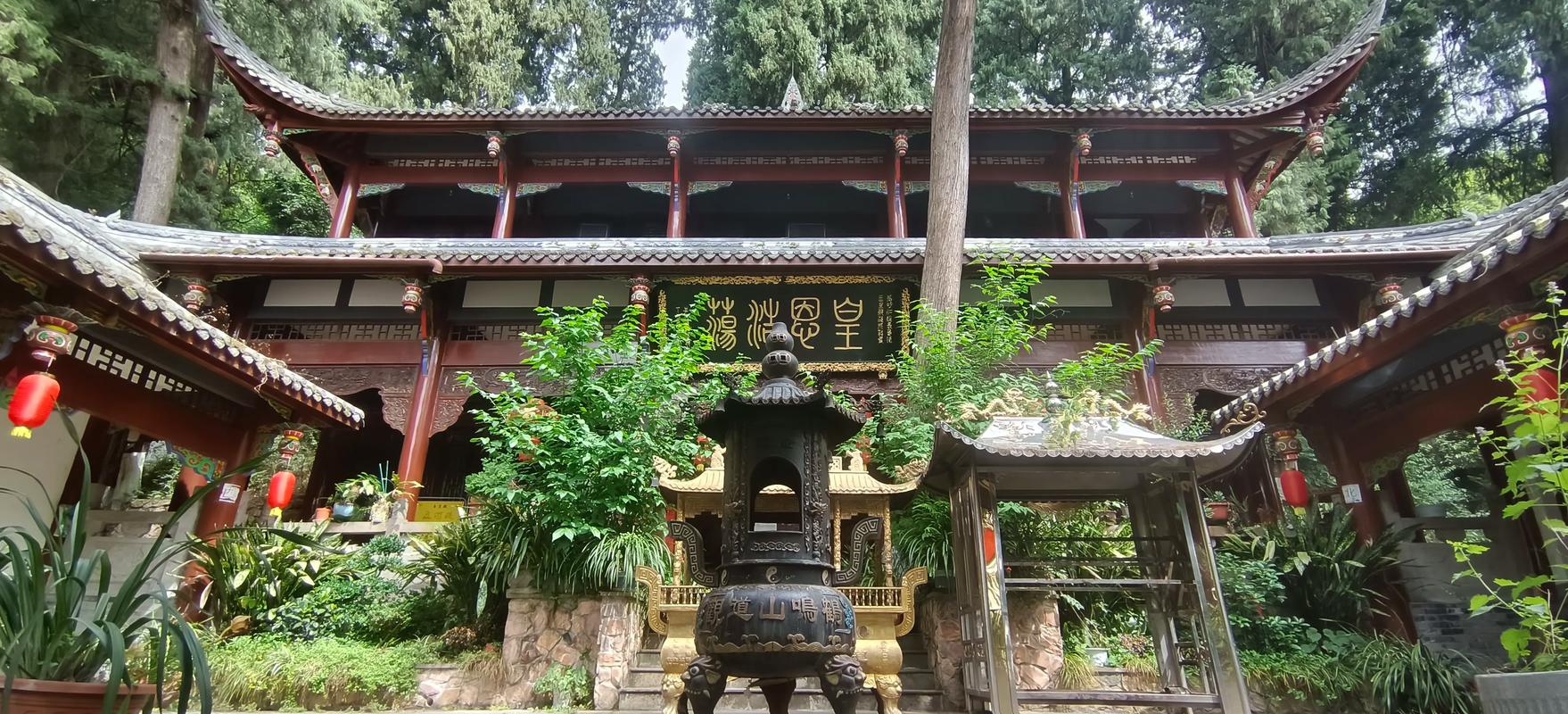
Chengdu is one of the most important centers of Taoist culture in China, surrounded by several renowned mountains with deep Taoist traditions.
Taoism has always had a close connection with the mountains. To Taoists, mountains are more than beautiful natural landscapes—they are places for spiritual practice, retreat, teaching, and the pursuit of the Tao, or “the Way.”
Unlike ordinary scenic destinations, Chengdu’s Taoist mountains combine remarkable natural landscapes with centuries-old religious traditions. They are home to historic Taoist temples, sacred sites, and living traditions that have been passed down for generations, including the Tianshi tradition and Quanzhen Taoism.
Among them is Mount Qingcheng, one of China’s Four Great Taoist Mountains, as well as Mount Heming, which is closely associated with the early history of the Tianshi tradition.
If you are interested in Chinese traditional religion, Taoist philosophy, ancient architecture, or the relationship between spirituality and nature in Chinese culture, the Taoist mountains around Chengdu offer a very different kind of journey through Sichuan—one that goes far beyond the usual tourist experience.
01 Mount Qingcheng
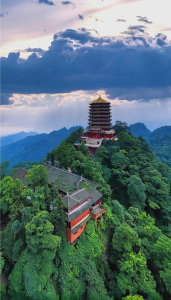 One of China’s Most Famous Taoist Mountains
If you can only visit one Taoist mountain near Chengdu, Mount Qingcheng is an easy choice.
Located in Dujiangyan, Chengdu, Mount Qingcheng is one of China’s most famous Taoist mountains and an important center of traditional Taoist culture. Together with Mount Wudang in Hubei, Mount Longhu in Jiangxi, and Mount Qiyun in Anhui, it is known as one of China’s Four Great Taoist Mountains.
Mount Qingcheng is best known for its peaceful and secluded scenery, traditionally described as “Qingcheng, the most secluded mountain under heaven.” Unlike mountains famous for dramatic peaks and steep cliffs, Qingcheng is characterized by dense forests, streams, ancient trees, and quiet mountain paths.
The Front Mountain is home to many historic Taoist temples and sites, including Tianshi Cave, Shangqing Palace, Zushi Hall, Jianfu Palace, and Laojun Pavilion.
According to Taoist tradition, after Zhang Daoling established the Tianshi tradition in Sichuan during the Eastern Han Dynasty, Mount Qingcheng gradually became an important center for Taoist practice and teaching.
Today, visiting Mount Qingcheng is about more than enjoying its natural beauty. It offers a chance to experience a living mountain tradition where nature, ancient architecture, and Taoist culture continue to exist side by side.
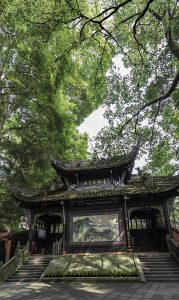 Visitor Information
Address: Qingchengshan Road, Qingchengshan Town, Dujiangyan, Chengdu, Sichuan
Admission: Front Mountain: RMB 80, including access to all major Taoist temples with no additional temple entrance fees
Back Mountain: RMB 20. Prices may vary, so please check the latest ticket information before your visit.
Opening Hours:
April 1–October 31: 8:00 AM–5:30 PM
November 1–March 31: 8:30 AM–5:00 PM
How to Get There
From Chengdu Shuangliu International Airport
One convenient option is to take the metro into Chengdu, travel to Xipu Station, and then transfer to the intercity train to Qingchengshan Railway Station. From the station, take the scenic-area shuttle bus to the mountain entrance.
The entire journey takes approximately 2.5 hours, depending on connections.
Shuangliu International Airport → Metro Line 10 → Taipingyuan Station → Metro Line 7 → Yipintianxia Station → Metro Line 2 → Xipu Station → Intercity train → Qingchengshan Station → Scenic-area shuttle bus
If you have luggage or prefer a more convenient journey, taking a taxi or booking a private transfer directly from the airport is also a good option.
From Chengdu Tianfu International Airport
The entire journey takes approximately 3 hours, depending on connections.
Tianfu International Airport → Metro Line 18 → South Railway Station → Metro Line 1 → Tianfu Square Station → Metro Line 2 → Xipu Station → Intercity train → Qingchengshan Station → Scenic-area shuttle bus
From Chengdu East Railway Station
The entire journey takes approximately 2 hours, depending on connections.
Take Metro Line 2 directly to Xipu Station, then transfer to the intercity train to Qingchengshan Railway Station. From the station, take the scenic-area shuttle bus to the mountain.
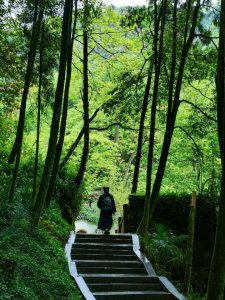 What to See
If your main interest is Taoist culture, a good route is:
Jianfu Palace → Tianshi Cave → Shangqing Palace → Laojun Pavilion
Tianshi Cave is one of the most important Taoist sites on Mount Qingcheng, while Shangqing Palace, located higher up the mountain, offers a particularly beautiful combination of Taoist architecture, forest scenery, and traditional spiritual culture.
Allow yourself plenty of time to walk between the temples rather than rushing from one site to another. The mountain itself is an important part of the experience.
02 Mount Heming
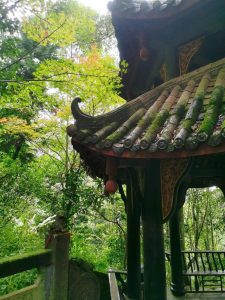 Tracing the Origins of Early Taoism in China
If Mount Qingcheng represents the mature mountain tradition of Taoism in Sichuan, Mount Heming is the place to visit if you want to explore the early history and origins of Taoism in China.
Mount Heming is widely recognized as one of the birthplaces of Taoism and an ancestral mountain of the Tianshi (Celestial Masters) tradition. It holds an important place in Taoist history and is located in Dayi County, Chengdu, approximately 70 kilometers from downtown Chengdu.
According to traditional Taoist accounts, Zhang Daoling practiced and taught Taoism here during the Eastern Han Dynasty and established the early Tianshi tradition at Mount Heming. For this reason, the mountain is widely regarded as one of the most important birthplaces of Taoism in China.
Together with Mount Qingcheng, Mount Heming forms an important part of the historical landscape of Taoism in Sichuan.
The mountain itself has a peaceful, natural character, with pine and cypress trees, streams, valleys, and historic Taoist buildings scattered throughout the landscape. Notable sites include Sangong Temple, Wenchang Palace, Taiqing Palace, and Yingxian Pavilion.
Compared with Mount Qingcheng, Mount Heming is quieter and less developed as a tourist destination. It is particularly appealing to travelers who want to escape the crowds and explore the deeper history of Chinese Taoism.
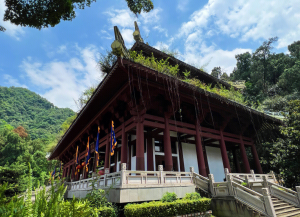 Visitor Information
Address: Sanfeng Village, Heming Town, Dayi County, Chengdu, Sichuan
Admission: The area around the main peak and the historic Taoist temples is currently free to visit. Daoyuan Shengcheng (Taoist Origin Sacred City) is a separate paid attraction. Ticket policies may change, so it is recommended to check the latest information before your visit.
Opening Hours: The Mount Heming scenic area is generally open year-round. The Taoist temple area typically opens from 8:30 AM to 5:30 PM.
How to Get There
From Chengdu Shuangliu International Airport
Take Metro Line 10 from the airport to Huaxing Station, then transfer to Metro Line 9 to Chengdu West Railway Station. From there, take an intercity train to Dayi Railway Station, then take a taxi to the scenic area.
The journey takes approximately 2.5 hours, depending on connections.
From Chengdu Tianfu International Airport
Take Metro Line 18 from the airport to Chengdu South Railway Station, then take an intercity train to Dayi Railway Station. From Dayi Station, take a taxi to Mount Heming.
The journey takes approximately 2.5 hours.
From Chengdu East Railway Station
Take Metro Line 2 to Xipu Station, then transfer to a train to Dayi Railway Station. From the station, take a taxi to the entrance of the scenic area.
The entire journey takes approximately 2 hours, depending on the train schedule and transfers.
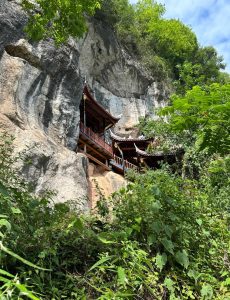 Why Visit Mount Heming?
If you are interested in Zhang Daoling, the Tianshi tradition, the origins of Taoism, or the history of Chinese religion, Mount Heming offers far more than a typical sightseeing experience.
You are not simply visiting another mountain. You are tracing the early footsteps of Taoism and exploring a place deeply connected with its origins.
For Taoist culture enthusiasts from around the world, Mount Heming offers a rare opportunity to explore the roots of Chinese Taoism in a peaceful and relatively undiscovered setting—a place to step away from the crowds, reconnect with nature, and experience the spiritual heritage of Taoism.
03 Mount Laojun
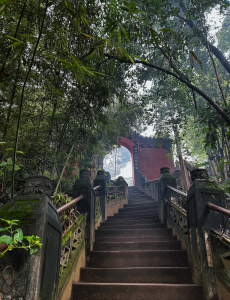 A Quiet Taoist Mountain in Southern Chengdu
Hidden away in Xinjin District, Chengdu, Mount Laojun is a relatively low-profile Taoist mountain that offers a much quieter experience than Chengdu’s better-known attractions.
Located in Yongshang Town, Mount Laojun is an important Taoist cultural site in western Sichuan. Compared with Mount Qingcheng and Mount Heming, it is less well known among international visitors and generally much less crowded. It is an ideal place to walk through the mountains, slow down, and experience the simple and down-to-earth Taoist traditions of Sichuan.
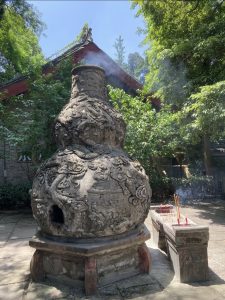
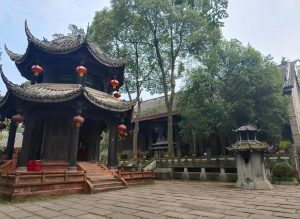
Taoist buildings are scattered along the slopes of the mountain, surrounded by lush vegetation and peaceful woodland. The area preserves not only traditional Taoist architecture and religious practices, but also aspects of local Sichuan customs and folk culture.
The mountain’s name itself comes from Laojun, a revered title for Laozi, one of the most important figures in Taoism.
If you have already visited Mount Qingcheng and are looking for a quieter Taoist mountain away from the crowds, Mount Laojun is well worth considering.
Visitor Information
Address: Junshan Road, Yongshang Town, Xinjin District, Chengdu, Sichuan
Admission: Free of charge. Some facilities or activities may have separate fees, so it is recommended to check locally before your visit.
Opening Hours: 8:00 AM–6:00 PM
 How to Get There
From Chengdu Shuangliu International Airport
Take Metro Line 10 from the airport to Rulin Road Station. Exit at Exit C1, then take a taxi to the entrance of Mount Laojun.
The journey takes approximately 1 hour.
From Chengdu Tianfu International Airport
Take Metro Line 19 from the airport to Shuangliu Airport Terminal 2 East Station, then transfer to Metro Line 10 and get off at Rulin Road Station. Exit at Exit C1 and take a taxi to the mountain.
The journey takes approximately 2 hours.
From Chengdu East Railway Station
Take Metro Line 7 (Inner Ring) to Taipingyuan Station, then transfer to Metro Line 10 and get off at Rulin Road Station. Exit at Exit C1 and continue by taxi to Mount Laojun.
The journey takes approximately 1 hour 40 minutes.
 Why Visit Mount Laojun?
Mount Laojun is particularly suited to travelers who have already explored Chengdu’s major attractions and want to discover how Taoist traditions remain connected to everyday local life.
It does not have the large-scale tourist infrastructure of Mount Qingcheng, and that is precisely part of its appeal. Instead, it offers a more intimate glimpse into the local Taoist traditions and cultural landscape of Sichuan.
For those looking for a quieter journey, a peaceful mountain walk, and a less touristy side of Taoism, Mount Laojun offers a refreshing alternative to Chengdu’s more famous destinations.