Shanghai is best known as a cosmopolitan city where East meets West—a modern skyline of soaring skyscrapers, historic architecture, and bustling commercial districts. Yet hidden among its busy streets are several Taoist temples that preserve centuries, and in some cases more than a millennium, of religious and cultural heritage.
These temples embody traditional Taoist beliefs surrounding sacred realms, harmony between yin and yang, longevity, blessings, and spiritual cultivation. At the same time, they have become deeply intertwined with Shanghai’s local customs and everyday urban life. Each has its own distinctive history, pantheon of deities, architectural traditions, and forms of prayer and blessing.
1. Shanghai City God Temple
A Major Zhengyi Taoist Temple and a Landmark of Old Shanghai Folk Culture
Address: 249 Fangbang Middle Road, Huangpu District
Opening Hours: 8:30 a.m.–4:30 p.m.
Admission: RMB 10 incense offering ticket
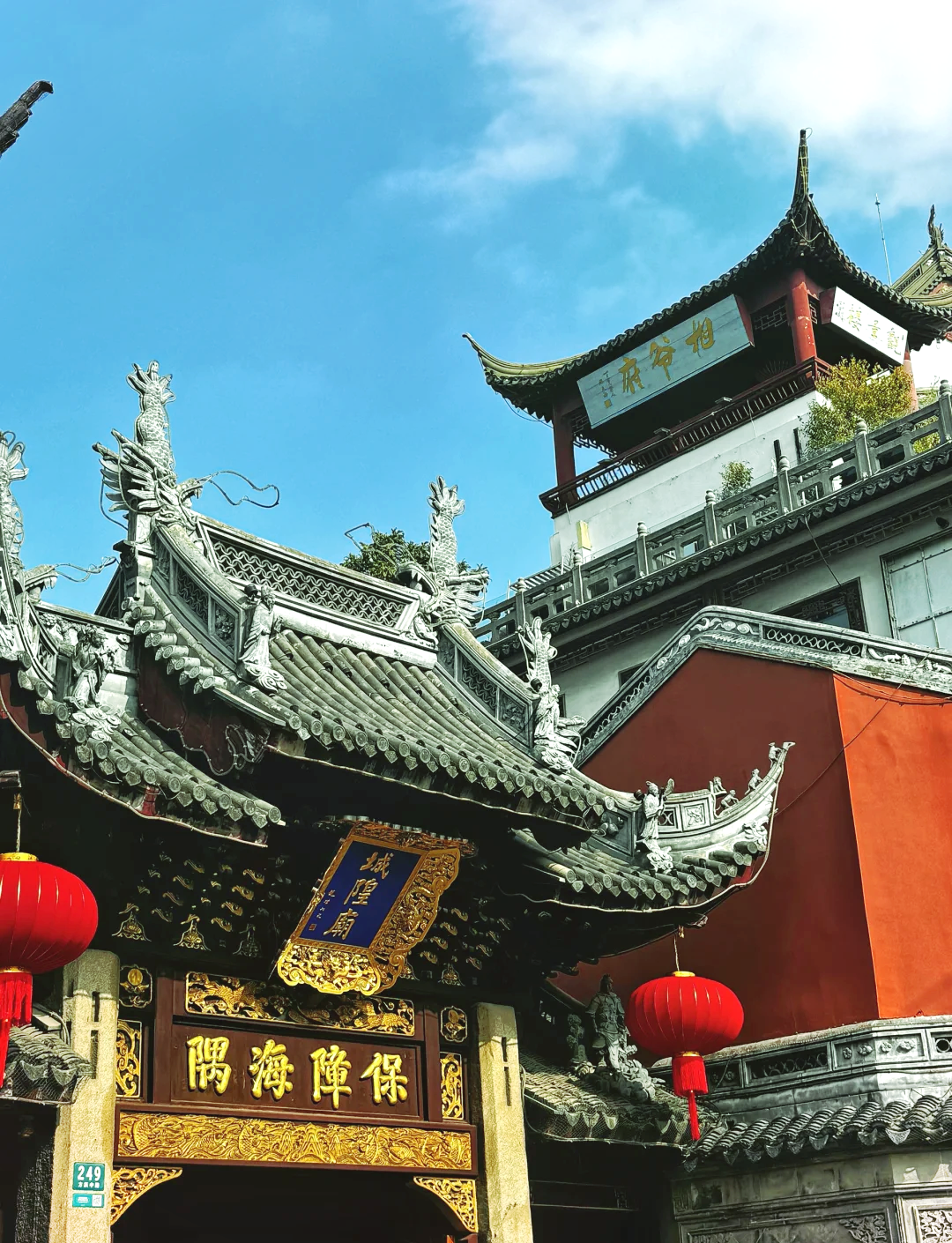
The Shanghai City God Temple dates back to the Yongle period of the Ming Dynasty in the early 15th century. Converted from an earlier temple dedicated to the deity of Jinshan, it has a history of more than 600 years.
It is traditionally regarded as one of the major City God temples of the Yangtze River region and is an important center of the Zhengyi tradition of Taoism in Shanghai. More than simply a religious site, the temple has long been closely connected with the history, folk customs, and community life of Shanghai’s Old City.
Architecturally, the temple is a classic example of Ming- and Qing-style Jiangnan religious architecture. Its three-courtyard layout features traditional brick, stone, and wood carvings, together with the distinctive upturned eaves associated with historic temples south of the Yangtze River.
The Unique “Three City Gods in One Temple”
One of the temple’s most distinctive features is its unusual tradition of honoring three City Gods within a single temple.
The front hall honors Huo Guang, a celebrated general and statesman of the Han Dynasty who became associated with the protection of the Jinshan region and Shanghai’s coastal territory.
The main hall is dedicated to Qin Yubo, a respected Shanghai scholar who lived during the transition from the Yuan to the Ming Dynasty. According to tradition, Emperor Zhu Yuanzhang, founder of the Ming Dynasty, appointed him as the City God of Shanghai, entrusting him with the spiritual protection of the city and its people.
The rear hall honors Chen Huacheng, a Qing Dynasty general remembered for his resistance against British forces during the First Opium War. He later became revered as a symbol of loyalty, courage, and protection of the nation.
Together, these three figures represent the protection of the city, the safeguarding of its people, and defense against danger and misfortune.
Above the temple entrance is the inscription “保障海隅”, which can be understood as “Safeguarding the Coastal Realm.” It reflects the temple’s historical role in protecting Shanghai when it was still a coastal walled city vulnerable to raids and maritime threats.
Another famous feature is a traditional couplet beside the entrance, conveying a straightforward moral message:
“Whether you do good or evil in this world is your own choice; but before the judgment of the underworld, who has ever escaped the consequences?”
Inside the main hall is another symbolic object known as the “Bù Yóu Rén Suàn” (不由人算) Abacus, literally suggesting that the ultimate reckoning of one’s deeds is “not determined by human calculation.”
Together, these symbols express the Taoist concepts of moral consequence, the accumulation of good and bad deeds, and the cyclical workings of the Heavenly Dao.
Where Taoism Meets Everyday Shanghai
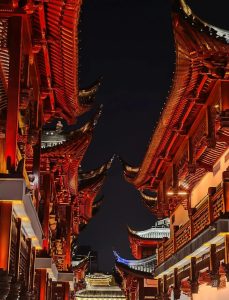
The temple stands beside the famous Yu Garden commercial district. For centuries, religious worship, street markets, food stalls, festivals, and everyday urban life have existed side by side here.
The area remains one of Shanghai’s most important venues for traditional celebrations, including the Lantern Festival, City God temple fairs, year-end blessing ceremonies, and Lunar New Year rituals for welcoming the God of Wealth.
In 1994, the temple was formally returned to the administration of the Shanghai Taoist Association. Traditional Taoist rituals, blessing ceremonies, divination practices, and religious services were subsequently restored.
Today, the Shanghai City God Temple is both an active Taoist institution and one of the city’s most recognizable windows into traditional Chinese religious culture.
Highlights & Why Visit
- A rare “Three City Gods in One Temple” tradition — an exceptional feature among China’s City God temples and an important site for understanding City God worship.
- Fine Jiangnan religious architecture — particularly noteworthy for its traditional brick, stone, and wood carvings.
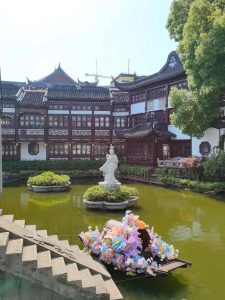
- A remarkable blend of religion and local culture — visitors can experience Zhengyi Taoist traditions while exploring the Old City, Yu Garden, traditional markets, and local food.
- Popular for prayers for peace, prosperity, good fortune, and protection from misfortune, especially during the Lunar New Year.
Getting There from Shanghai Pudong International Airport
1. Metro — Best Value
Approx. 75 minutes | Fare: around RMB 8
Take Metro Line 2 toward East Xujing from Pudong International Airport to East Nanjing Road Station. Transfer to Line 10 toward Hangzhong Road, get off at Yuyuan Garden Station, and use Exit 3. The temple is approximately 600 meters away on foot.
2. Maglev + Metro — Faster Option
Approx. 50 minutes
Take the Shanghai Maglev from Pudong Airport to Longyang Road Station, transfer to Metro Line 2 to East Nanjing Road, then transfer to Line 10 and continue to Yuyuan Garden Station.
This option is suitable for travelers with limited time.
3. Taxi / Ride-Hailing
Distance: approximately 45 km
Travel time: around 45 minutes
Estimated fare: around RMB 180
2. Shanghai Baiyun Taoist Temple
Shanghai’s Leading Quanzhen Longmen Temple and Home of the Shanghai Taoist Association
Address: 239 Dajing Road, Huangpu District
Opening Hours: 8:00 a.m.–4:30 p.m.
Admission: Free; the temple traditionally provides visitors with three incense sticks
Shanghai Baiyun Taoist Temple, also known as Hai Shang Bai Yun Guan (海上白云观), originated from a temple dedicated to the Taoist thunder deity Leizu, established in 1882 during the Qing Dynasty.
During the Guangxu period, Taoist master Xu Zhicheng, a practitioner of the Longmen lineage of the Quanzhen tradition, traveled to the famous Baiyun Temple in Beijing. The Shanghai temple subsequently became recognized as a southern branch of Beijing’s Baiyun Temple and formally adopted the name Hai Shang Bai Yun Guan, or Shanghai Baiyun Taoist Temple.
It developed according to the traditional Quanzhen monastic system and became one of the most important centers for the development of Quanzhen Taoism in modern Shanghai.
Today, it also serves as the headquarters of the Shanghai Taoist Association and is one of the city’s best places to experience the quieter, more contemplative side of Taoist religious life.
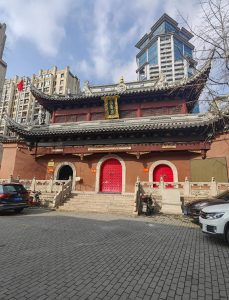
A Quiet Taoist Sanctuary Beside Shanghai’s Old City Wall
The temple follows a traditional courtyard layout with halls designed in Ming- and Qing-style architecture.
It stands beside the Dajing Pavilion section of Shanghai’s surviving Ming Dynasty city wall, creating an unusual historical setting in the middle of one of China’s largest modern cities.
Despite its central location, the temple is notably peaceful and feels removed from the noise of the surrounding streets.
The temple is particularly known for two important collections associated with Chinese Taoist heritage.
The first consists of nine bronze Taoist statues dating from the Ming and Qing dynasties. Seven of the gilded bronze statues date from the Ming Dynasty and were reportedly intercepted by customs authorities in the late Qing period, preventing them from being taken overseas.
The collection includes representations of important Taoist figures such as Zhenwu Dadi (the Perfected Warrior Emperor), Zhang Tianshi (Celestial Master Zhang), and Taoist guardian deities. The statues are outstanding examples of traditional Chinese Taoist bronze sculpture.
The second major cultural treasure historically associated with the temple is a complete Ming-era edition of the Zhengtong Daozang, or Zhengtong Taoist Canon, comprising more than 8,000 volumes. It was one of the most important collections of Taoist scriptures in modern Jiangnan. The original collection is now preserved at the Shanghai Library.
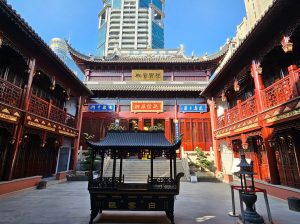
Traditional Quanzhen Monastic Layout
The temple halls are arranged along a central axis and include:
- the main gate, symbolizing the Taoist concept of the Three Powers of Heaven, Earth, and Humanity;
- Lingguan Hall;
- Lingxiao Hall;
- Leizu Hall;
- Sanqing Hall, dedicated to the Three Pure Ones, the highest Taoist divinities;
- Qiuzu Hall, honoring Qiu Chuji, one of the most influential masters of the Quanzhen tradition;
- and Doumu Hall, dedicated to Doumu, an important celestial mother deity associated with the stars.
The temple maintains traditional Quanzhen practices, including morning and evening scripture recitation, meditation, spiritual cultivation, and Taoist ritual ceremonies.
Compared with some of Shanghai’s more heavily visited religious attractions, Baiyun Temple retains a relatively restrained and contemplative atmosphere. Many visitors come specifically for quiet worship, meditation, or an introduction to traditional Taoist monastic life.
In 2004, the temple complex was relocated and reconstructed as part of urban redevelopment, while its traditional architectural arrangement and important cultural relics were preserved. It is now officially protected as a cultural heritage site in Huangpu District.
Highlights & Why Visit
- Shanghai’s principal Quanzhen Longmen Taoist center — an excellent counterpart to the Zhengyi tradition represented by the City God Temple. It is particularly suitable for visitors interested in Taoist meditation, spiritual cultivation, and monastic practices.
- Important Ming Dynasty bronze Taoist statues — a must-see collection for anyone interested in Chinese religious sculpture and Taoist iconography.
- Headquarters of the Shanghai Taoist Association — an important center for Taoist administration, cultural research, education, and academic exchange in Shanghai.
- A Taoist temple beside a surviving Ming Dynasty city wall — ideal for travelers seeking a quieter historical and cultural experience away from Shanghai’s busiest attractions.
Getting There from Shanghai Pudong International Airport
1. Metro
Approx. 80 minutes
Take Metro Line 2 from Pudong International Airport to Lujiazui Station, transfer to Line 14 toward Fengbang, and get off at Dashijie Station. Leave from Exit 5 and walk approximately 800 meters to the temple.
2. Taxi / Ride-Hailing
Distance: approximately 48 km
Travel time: around 50 minutes
Estimated fare: around RMB 175
3. Qinci Yangdian Taoist Temple
Also Known as Taiqing Palace — An Ancient Dongyue Taoist Temple and Major Tai Sui Worship Site in Shanghai
Address: 476 Yuanshen Road, Pudong New Area
Opening Hours: 8:00 a.m.–4:30 p.m.
Admission: RMB 5 incense offering ticket, including three incense sticks
Qinci Yangdian (钦赐仰殿), also known as Taiqing Palace, is widely regarded as one of the oldest surviving Taoist temple traditions in Shanghai.
Its origins are traditionally traced to the Chiwu period of the Eastern Wu kingdom during the Three Kingdoms era. According to legend, Sun Quan, ruler of Eastern Wu, established a temple here to pray for blessings for his mother, Lady Wu.
During the Ming Dynasty, the temple developed into a Dongyue sanctuary, with Dongyue Dadi, the Great Emperor of the Eastern Peak, as its principal deity.
In 1770, during the reign of the Qianlong Emperor of the Qing Dynasty, the temple received the imperial designation “Qinci Yangdian”, giving rise to its present name. It is notable in Shanghai for its association with an imperial bestowal.
In 2017, the temple was officially designated a protected cultural heritage site in Shanghai.
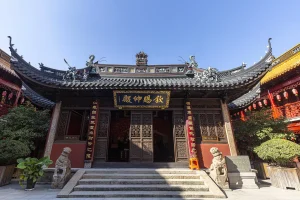
Ancient Taoist Architecture Against the Pudong Skyline
The temple complex covers more than 7,000 square meters and is traditionally arranged according to Taoist cosmological principles associated with the Nine Heavens.
The complex can broadly be divided into four areas: the Dongyue main hall area, the halls dedicated to the Three Pure Ones, the Tai Sui worship area, and the scripture pavilion.
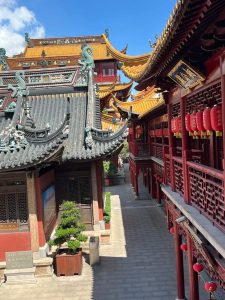
With red walls, yellow-tiled roofs, elaborate eaves, and imposing halls, the temple has a distinctly traditional appearance.
One of its most striking features is its relationship with the surrounding Pudong skyline. From the upper corridors, visitors can see traditional Taoist roofs and pavilions in the foreground while the skyscrapers of Lujiazui rise in the distance.
The juxtaposition of an ancient Taoist sanctuary and Shanghai’s futuristic financial district makes this one of the city’s most distinctive places for photography.
Dongyue Worship and Shanghai’s Tai Sui Tradition
Qinci Yangdian is an important center of Dongyue worship in eastern China.
The principal Dongyue Hall honors Dongyue Dadi, together with Bixia Yuanjun and Bingling Gong. Other halls contain representations associated with the Ten Kings of the Underworld and traditional spiritual officials governing the realms of yin and yang.
Dongyue Dadi has traditionally been associated with the administration of life, death, fate, protection from calamity, and longevity.
The temple is particularly famous for its Hall of the Sixty Tai Sui Deities, representing the sixty-year cycle of traditional Chinese calendrical cosmology.
In Chinese folk and Taoist tradition, each year is governed by a particular Tai Sui, or annual celestial deity. People whose zodiac signs are believed to conflict with the ruling Tai Sui of a particular year may visit the temple to perform prayers and rituals traditionally known as “appeasing Tai Sui” (An Tai Sui).
Qinci Yangdian is one of Shanghai’s best-known temples for this practice. During the Lunar New Year period, large numbers of worshippers come to pray for protection, stability, and relief from difficulties associated with the coming year.
The temple also contains halls dedicated to the God of Wealth, Wenchang, the deity associated with scholarship and examinations, Yuelao, traditionally associated with marriage and relationships, and the Medicine King, associated with health and healing.
As a result, visitors come here to pray for a wide variety of blessings, including prosperity, academic success, relationships, longevity, health, and protection from misfortune.
On the 28th day of the third lunar month, traditionally celebrated as the birthday of Dongyue Dadi, the temple hosts major religious and folk celebrations. These may include temple fairs, processions, traditional rituals, and large-scale Taoist ceremonies.
The temple is also involved in charitable programs, free medical consultations, and services for elderly residents, maintaining a strong connection with the surrounding community.
Highlights & Why Visit
- One of Shanghai’s most ancient Taoist temple traditions and a temple associated with an imperial designation — particularly valuable for visitors interested in the early history of Taoism in Shanghai.
- One of Shanghai’s best-known places for Tai Sui worship — especially popular among worshippers seeking protection and good fortune for the year ahead.
- A remarkable visual contrast between an ancient Taoist temple and the Lujiazui skyline — one of the city’s most distinctive combinations of traditional and modern Shanghai.
- Conveniently located in Pudong — making it the easiest of these three temples to visit after arriving at Pudong International Airport. The temple offers opportunities to pray for longevity, prosperity, academic success, relationships, health, and general good fortune.
Getting There from Shanghai Pudong International Airport
1. Metro — Recommended Route
Approx. 60 minutes with relatively few transfers
Take Metro Line 2 from Pudong International Airport to Century Avenue Station, transfer to Line 6 toward Gangcheng Road, and get off at Yuanshen Sports Center Station. Leave via Exit 4 and walk approximately 300 meters to the temple entrance.
2. Taxi / Ride-Hailing
Distance: approximately 42 km
Travel time: around 40 minutes
Estimated fare: around RMB 160
Among the three temples listed here, Qinci Yangdian is the most convenient to reach from Pudong International Airport.
Recommended One-Day Taoist Temple Itinerary in Shanghai
For travelers arriving through Shanghai Pudong International Airport, the following route provides a convenient itinerary without unnecessary backtracking:
Shanghai Pudong International Airport → Qinci Yangdian → Shanghai Baiyun Taoist Temple → Shanghai City God Temple
First Stop: Qinci Yangdian
Begin in Pudong with the temple closest to the airport. Explore Shanghai’s ancient Dongyue and Tai Sui traditions while enjoying the unusual contrast between Taoist architecture and the modern Lujiazui skyline.
Second Stop: Shanghai Baiyun Taoist Temple
Cross the Huangpu River into Shanghai’s historic urban core and visit this peaceful Quanzhen temple. Take time to appreciate its Taoist sculptures, traditional monastic atmosphere, and the nearby remains of Shanghai’s old city wall.
Final Stop: Shanghai City God Temple
Finish the day in the lively Old City. After visiting the temple and experiencing Shanghai’s City God traditions, explore the surrounding Yu Garden district, traditional streets, shops, and local food.
This final stop offers an ideal combination of Taoist culture, traditional Shanghai folk customs, sightseeing, and dinner, bringing the day’s journey from ancient spiritual traditions back into the vibrant everyday life of modern Shanghai.