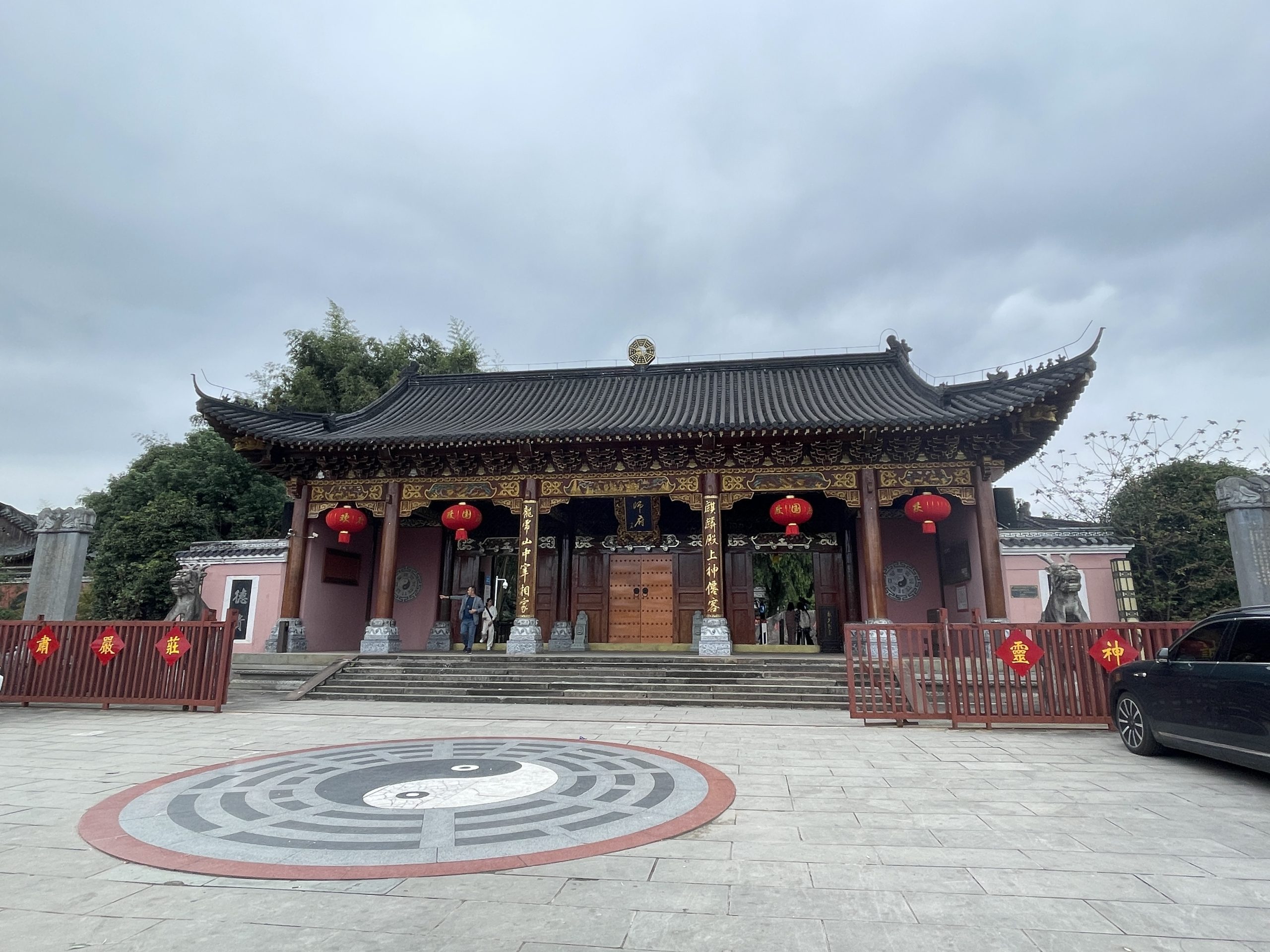
Longhu Mountain in Jiangxi is one of the most representative sacred mountains in the history of Chinese Taoist culture.
Here, you will find spectacular Danxia landscapes, ancient cliff tombs with hanging coffins, and a Taoist tradition that has continued for thousands of years. More importantly, Longhu Mountain is regarded as an important ancestral home of Zhengyi Taoism and has a close connection with the development of the Celestial Masters tradition. The famous tradition of the “Celestial Masters” in Chinese Taoist history has left a profound influence here.
Longhu Mountain is the birthplace of institutionalized Taoism in China, the ancestral home of Zhengyi Taoism (the Celestial Masters tradition), and a core sacred site for talismanic culture, Taoist ritual ceremonies, and the transmission of Taoist ordination. Here, green mountains and clear waters meet, spectacular Danxia peaks rise throughout the landscape, and the Luxi River runs through the area. It combines extraordinary natural scenery with nearly two thousand years of orthodox Taoist tradition, making it a must-visit destination for international visitors interested in Taoist culture, ancient architecture, and traditional symbolic art.
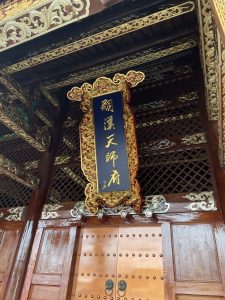
Longhu Mountain takes its name from a legend dating back to the Eastern Han Dynasty. Zhang Daoling, the founder of Taoism, is said to have built a retreat here to practice alchemy. On the day his elixir was successfully completed, a dragon and a tiger appeared, and the mountain was therefore named “Longhu Mountain,” meaning “Dragon and Tiger Mountain.” From the 2nd century CE onward, Zhang Daoling established the Zhengyi Mengwei tradition (Celestial Masters tradition) here, creating China’s first fully organized and institutionalized Taoist school and beginning a thousand-year tradition of orthodox Taoist transmission.
For nearly 1,900 years, 64 generations of Celestial Masters passed down the Taoist tradition, with successive generations residing at the Celestial Masters Mansion. This made Longhu Mountain the ancestral home and source of the Zhengyi tradition for Taoists around the world. While other famous Taoist mountains tend to emphasize mountain cultivation and internal alchemy, Longhu Mountain focuses on talismans, Thunder Rituals, Taoist ritual ceremonies, and ordination, making it a central source of China’s talismanic culture and ritual traditions for communication between humans and the divine.
In addition to its profound Taoist heritage, Longhu Mountain is also home to two world-class wonders: its distinctive Danxia peaks and forests, and the ancient hanging-coffin cliff tombs of the Guyue people, whose origins remain mysterious. The combination of mountains, water, cultural heritage, and ancient civilization makes it a unique multi-layered Taoist sacred mountain in China.
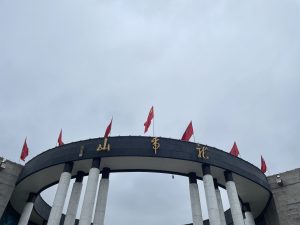
1. Celestial Masters Mansion (Shangqing Celestial Masters Mansion)
The Celestial Masters Mansion, also known as the Shangqing Celestial Masters Mansion, is known as the “First Family of Southern China.” It was the residence of successive Celestial Masters and their descendants, as well as a place where they transmitted Taoist teachings and conducted ordination ceremonies.
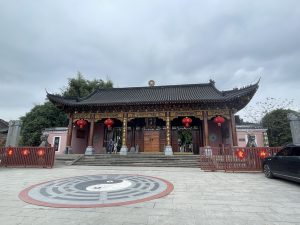
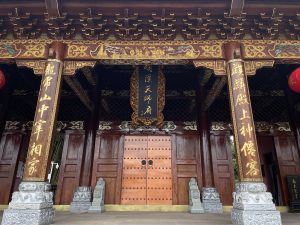
The Celestial Masters Mansion is not an ordinary Taoist temple. It has multiple layers of significance, combining religious traditions, family heritage, and historical transmission. Successive Celestial Masters conducted Taoist affairs here, gradually establishing Longhu Mountain as an important center of Zhengyi Taoism.
The buildings seen today have undergone repeated reconstruction and development, but they still reflect the combination of traditional Taoist architectural principles and the family-based system of the Celestial Masters.
Inside the mansion, ancient trees stand among orderly halls and buildings. Numerous ancient stone inscriptions, plaques, and an old opera stage have been preserved, making it one of the most complete Taoist architectural complexes in terms of traditional religious regulations and one of the most continuous centers of Taoist transmission. Many ordination and register-transmission ceremonies of the Zhengyi tradition are held here, making it a core cultural site of Longhu Mountain’s Taoist heritage.
2. Shangqing Palace
A thousand-year-old imperial Taoist monastery, Shangqing Palace served as a ritual site where successive Celestial Masters worshipped the deities and performed major Taoist ceremonies. With its grand scale and prestigious status, it was one of the highest-level Taoist ritual centers in ancient Jiangnan and preserves ancient traditions of Taoist ritual ceremonies, prayers for blessings, and rituals for averting disasters.
3. Zhengyi Temple
Zhengyi Temple is believed to be the place where Zhang Daoling first practiced alchemy, attained enlightenment, and established his religious tradition. It is one of the oldest Taoist sites on Longhu Mountain.
Quiet, simple, and secluded, it is a key location for tracing the origins of Taoism.
4. Luxi River Bamboo Raft Ride & Hanging Coffin Landscape
Longhu Mountain is not only home to Taoist culture but also to distinctive Danxia landscapes. If Longhu Mountain is understood only as a Taoist sacred mountain, visitors may miss another very important aspect of the area.
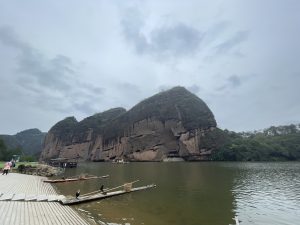
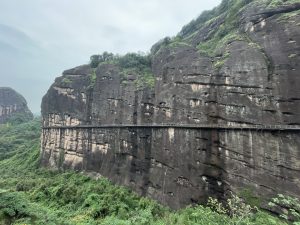
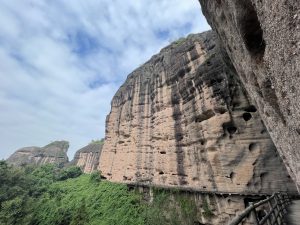
Longhu Mountain is one of China’s famous Danxia landscape regions. Its mountains are formed from red sandstone, which has been shaped over long periods by geological movements and water erosion, creating numerous peaks, cliffs, caves, and valleys.
The Luxi River flows between the mountains, creating a distinctive landscape where mountains and water exist in harmony. This natural environment also has a close connection with the traditional Chinese concept of sacred mountains. In ancient China, famous mountains were often regarded not only as natural landscapes, but also as important spaces for divine activity, spiritual cultivation, and religious worship.
In addition to its Taoist heritage, Longhu Mountain is also famous for its hanging coffins, a remarkable cultural relic. Ancient coffins can be found on the steep cliffs surrounding Longhu Mountain.
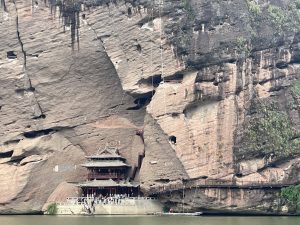
Hanging coffins are not unique to Longhu Mountain; similar remains can also be found in several areas of southern China. Their exact dates, cultural background, and origins as burial customs have long been important subjects of historical and archaeological research.
Riding a bamboo raft through the Danxia landscape allows visitors to see the ancient hanging coffins on the cliffs as well as the extraordinary peaks and rock formations, experiencing the unique atmosphere of Longhu Mountain, where “the mountains and waters embody the Tao, and the natural world becomes the altar.” At scheduled times, the scenic area also presents a hanging-coffin lifting performance, recreating aspects of the ancient Guyue burial culture.
Longhu Mountain and the “Three Mountains Talisman Tradition”
In the history of Chinese Taoist talismans, Longhu Mountain is often associated with the “Three Mountains Talisman Tradition.”
The “Three Mountains” generally refer to:
Longhu Mountain, Gezao Mountain, and Mount Mao.
The three mountains are closely associated with important Taoist traditions such as Zhengyi, Lingbao, and Shangqing.
The Celestial Masters and Zhengyi traditions represented by Longhu Mountain emphasize ordination, talismans, and Taoist ritual ceremonies;
Gezao Mountain is closely associated with the Lingbao tradition and has played an important role in salvation rituals for the deceased, Taoist ceremonies, and large-scale religious rituals;
Mount Mao is closely associated with the Shangqing tradition and has played an important role in visualization practices, scripture recitation, internal cultivation, and systems of divine beings.
Together, these three mountains form an important historical lineage of Chinese Taoist talismanic culture.
Information
Address: Longhu Mountain Scenic Area, Yingtan, Jiangxi Province, China
Tickets: Scenic area admission: RMB 90; Full sightseeing package (including shuttle bus and bamboo raft): RMB 230 (valid for two days)
Opening Hours:
Peak Season (March–November): 08:00–17:30 (last admission at 16:30)
Off Season (December–February): 08:30–17:10 (last admission at 16:30)
Transportation Guide (Airport / High-Speed Rail Station)
From Nanchang Changbei International Airport
Take a high-speed train from the airport to Yingtan North Railway Station. From the station, take the K2 tourist shuttle or a taxi directly to Longhu Mountain Scenic Area. The entire journey takes approximately 1.5 hours.
From Yingtan North Railway Station (High-Speed Rail)
After leaving the station, take the K2 tourist bus, which takes approximately 40 minutes to reach the scenic area’s visitor center. A taxi takes approximately 30 minutes, making transportation convenient.
Travel Tips
The Celestial Masters Mansion and Shangqing Palace are traditional Taoist religious sites. Visitors should remain quiet, dress appropriately, and respect religious customs.
Exploring the scenic area involves walking and taking a bamboo raft. Comfortable shoes and socks are recommended.
Longhu Mountain is particularly suitable for in-depth cultural travel. It is recommended to allow a full day to fully experience both its Danxia landscapes and its thousand-year Taoist heritage.
China’s Four Great Taoist Mountains
Hubei · Wudang Mountain | The No. 1 Immortal Mountain in China
(Quanzhen Taoism · Sacred site of Emperor Zhenwu)
Jiangxi · Longhu Mountain | Ancestral Home of the Celestial Masters
(Zhengyi Taoism · Birthplace of the Celestial Masters tradition)
Sichuan · Qingcheng Mountain | “The Most Secluded Place Under Heaven”
(Birthplace of Taoism · Ancestral Mountain of the Grotto-Heavens)
Anhui · Qiyun Mountain | The First Famous Mountain of Jiangnan
(Jiangnan Zhengyi Taoism · Qingwei Sacred Land)