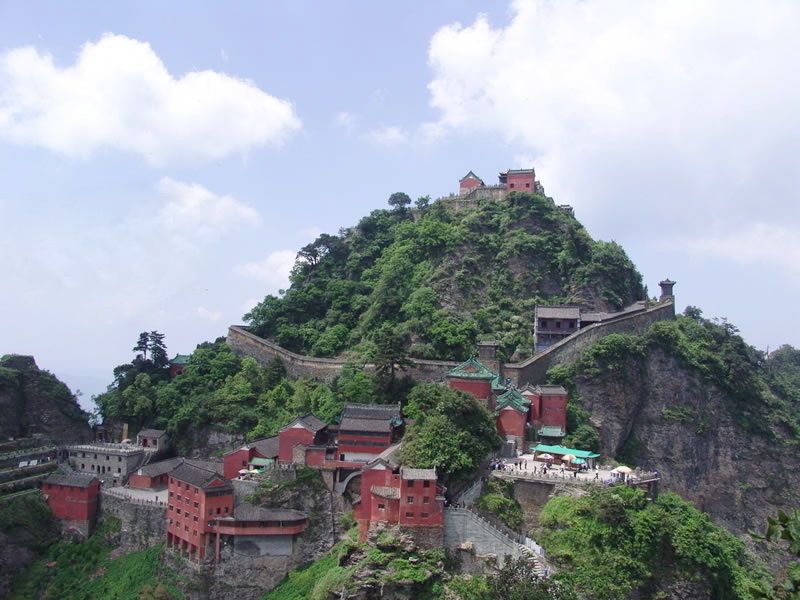
Where the Immortal Mountains Meet the Martial Way, and Tai Chi Embraces the Balance of Heaven and Earth
Located in Shiyan City, Hubei Province, Wudang Mountain is one of China’s most famous Taoist mountains and an important center for the development and transmission of traditional Chinese martial arts.
The mountain is known not only for its spectacular natural scenery but also for its extensive collection of historic Taoist temples and buildings. In 1994, the Ancient Building Complex of Wudang Mountain was inscribed on the UNESCO World Heritage List. The complex is regarded as an outstanding example of Chinese architecture, where religious traditions, mountain landscapes, and architectural design come together. Its historic buildings showcase the remarkable architectural skills and craftsmanship of the Yuan, Ming, and Qing dynasties, making Wudang Mountain a rare cultural treasure where both nature and human heritage can be experienced.
Wudang Mountain and Its Taoist Heritage
Wudang Mountain has a long history as a place of spiritual cultivation. According to historical and traditional accounts, hermits were already practicing meditation and seeking spiritual enlightenment here during the Qin and Han dynasties. During the Tang and Song dynasties, Wudang Mountain became an important site for imperial prayers and religious ceremonies.
The mountain reached its peak of development during the Ming Dynasty. Emperor Yongle of the Ming Dynasty famously ordered the construction of a large-scale Taoist complex at Wudang Mountain. This massive project created numerous palaces, temples, monasteries, and sacred sites across the mountains.
At the heart of Wudang’s religious tradition is the worship of Zhenwu, the True Warrior, one of the most important deities in Chinese Taoism.
Wudang Mountain is also closely associated with the legendary Taoist master Zhang Sanfeng, who is traditionally regarded as a major figure in the development of Wudang martial arts and the Taijiquan tradition. Because of this connection, Wudang Mountain has long been regarded in Chinese martial arts culture as an important center of internal martial arts and a spiritual home of Taijiquan.
Today, Wudang martial arts and Wudang Taoist ceremonial music are both recognized as important elements of China’s national intangible cultural heritage.
What Is Wudang Martial Arts?
Built upon centuries of Taoist culture, Wudang Mountain developed a rich and diverse martial arts tradition.
Unlike some traditional martial arts styles that place greater emphasis on physical strength and powerful strikes, Wudang martial arts traditionally emphasize mind, body, breath, balance, and movement.
Its philosophy is often associated with principles such as:
using softness to overcome hardness, remaining calm in motion, responding rather than forcing, and harmonizing the body with nature.
Wudang martial arts also draw upon traditional Taoist ideas such as yin and yang, the Five Elements, and the harmony between humanity and nature.
For this reason, Wudang martial arts have traditionally served several purposes: martial training, physical conditioning, self-cultivation, and spiritual practice.
The Wudang tradition includes a wide range of disciplines, including unarmed combat, palm techniques, swordsmanship, other traditional weapons, and internal training practices.
Below are some of the best-known forms associated with Wudang martial arts.
1. Wudang Taijiquan: The Core of the Tai Chi Tradition
Wudang Taijiquan, or Wudang Tai Chi, is one of the best-known forms of Wudang martial arts. Traditional Wudang teachings describe Tai Chi as part of a broader progression involving Taiji, Liangyi (Two Principles), and Wuji (the state of undifferentiated potential). Rather than being limited to a single routine, the tradition presents Tai Chi as a progressive practice involving physical movement, breath, awareness, and deeper self-cultivation.
Its movements are generally slow, continuous, circular, and relaxed. Practitioners focus on maintaining an upright posture, releasing unnecessary tension, coordinating the whole body, and maintaining a smooth connection between movement and breathing. One of its central principles is the balance between yin and yang, as well as the interaction between movement and stillness. From a martial perspective, traditional Tai Chi is not simply slow exercise. Techniques such as Peng, Lu, Ji, and An are associated with traditional applications involving redirection, balance, and controlled force. Rather than meeting force with force, Tai Chi traditionally emphasizes responding to an opponent’s movement, redirecting incoming energy, and maintaining control through positioning and body structure. Tai Chi is also widely practiced today as a form of gentle physical exercise and mind-body training.
2. Wudang Taiyi Five Elements Boxing
Taiyi Five Elements Boxing is a traditional Wudang boxing system associated with the Taoist concept of the Five Elements: Wood, Fire, Earth, Metal, and Water. The movements and techniques are traditionally interpreted through the relationships and transformations of these five elements. The style combines softness and strength, changes in speed, and continuous transitions between different techniques. Its footwork is flexible, while its hand techniques emphasize changes between empty and solid movements.
The system is traditionally practiced not only as martial training but also as a way of developing coordination, body awareness, and adaptability. Because many of its movements can be practiced within a relatively small space, it can also be suitable for regular training and personal cultivation.
3. Wudang Chunyang Boxing
Wudang Chunyang Boxing is traditionally associated with the concept of Chunyang, or “Pure Yang,” and reflects the influence of Taoist cultivation practices. The style is generally characterized by relaxed movements, stable stances, flowing hand techniques, and coordinated movement from the waist and hips. Rather than relying primarily on brute strength, traditional practice emphasizes positioning, timing, redirection, and controlled movement.
The name “Chunyang” also reflects the close relationship between Wudang martial arts and Taoist culture. Martial training in the Wudang tradition has historically been viewed not only as combat training but also as a means of cultivating discipline, calmness, and physical awareness.
4. Xuanwu Boxing
Xuanwu Boxing is traditionally presented as a more advanced Wudang boxing system, with an emphasis on practical martial skills and full-body coordination. Its movements combine stillness and movement, opening and closing, and changes between empty and solid positions. Compared with some more elaborate traditional routines, Xuanwu Boxing places greater emphasis on direct and practical movements. Training focuses on coordinating the hands, eyes, body, footwork, and timing. Its techniques emphasize whole-body movement and adaptability, making it a useful form of training for developing basic martial skills as well as practical responsiveness.
5. Wudang Yin-Yang Bagua Palm
Wudang Yin-Yang Bagua Palm is a traditional palm system influenced by the Taoist concepts of the Bagua (Eight Trigrams) and yin-yang transformation. Its most recognizable characteristic is circular walking. Practitioners continuously walk around a circle while changing their body direction, footwork, and palm techniques. The body turns with the steps, while the palms change according to the movement of the body. This creates a distinctive style based on continuous movement and changing angles. In traditional martial applications, Bagua Palm emphasizes mobility, evasion, positioning, and changing direction rather than confronting an opponent directly.
Instead of meeting an attack head-on, the practitioner seeks to move around it, change position, disrupt the opponent’s balance, and respond from a different angle. The relationship between Bagua Palm and the I Ching (Book of Changes) also reflects the traditional emphasis on transformation and adaptability.
6. Taiyi Xiaoyao Palm
Taiyi Xiaoyao Palm has a flowing and relaxed character that reflects the Taoist ideal of Xiaoyao — freedom, ease, and natural movement. Its techniques are generally smooth and continuous, combining movement and stillness without excessive stiffness or force. The hands move through changing patterns while the body remains relaxed and coordinated. Traditional practice emphasizes both physical flexibility and mental calmness. Its flowing movements make it visually graceful, while its palm techniques also contain traditional martial applications. For this reason, Taiyi Xiaoyao Palm is often regarded as a form of Wudang practice that particularly expresses the connection between martial arts and Taoist self-cultivation.
7. Wudang Taiji Sword
If Taijiquan represents the best-known unarmed tradition of Wudang martial arts, Wudang Taiji Sword is one of its most recognizable weapon traditions. Swordsmanship has a special place in Wudang culture. Taoist practitioners have traditionally been associated with carrying and practicing with the sword, and the weapon has become an important symbol of Wudang martial arts. Wudang swordsmanship emphasizes coordination between the sword, body, footwork, and intention. Traditional sword techniques include movements such as cutting, thrusting, pointing, lifting, sweeping, drawing, blocking, hanging, and piercing. The overall style is often characterized by smooth, controlled, and continuous movements.
Rather than simply moving the sword with the arm, practitioners use the movement of the waist, hips, body, and footwork to guide the sword. This creates the characteristic feeling of “body and sword moving as one.” Traditional Wudang swordsmanship also includes various branches and systems, such as Taiyi Xuanmen Sword and Taiyi Divine Sword. The exact techniques and lineages can vary between different schools, so “Wudang Sword” is best understood as a broad category rather than one single standardized routine.
8. Wudang Dan Sword
Wudang Dan Sword is traditionally associated with Taoist cultivation and the concept of Dan, or internal alchemical cultivation. Compared with the softer and more continuous movements often associated with Taiji Sword, Dan Sword combines softness and strength with changes in speed and rhythm. Its movements are generally structured and controlled, while the sword paths are clear and precise. Traditional training places importance on coordinating external movement with internal awareness, making the practice both a form of sword training and a method of self-cultivation.
9. Wudang Xuanwu Staff
Xuanwu Staff is a traditional Wudang staff system known for its practical and direct movements. The staff is traditionally used with coordinated body movement rather than relying solely on arm strength. Techniques can include sweeping, striking, thrusting, blocking, and changing direction, with an emphasis on smooth transitions between offense and defense. The practice is generally straightforward and functional rather than focused on decorative movements, making staff training an important part of traditional Wudang weapon practice.
10. Taiyi Fuchen: The Taoist Whisk
One of the most distinctive weapons associated with Wudang culture is the fuchen, a traditional Taoist whisk. Unlike a conventional weapon, the fuchen is primarily a Taoist ritual and symbolic object. In martial arts traditions, however, it has also been incorporated into specialized forms of training. Because the whisk is flexible and lightweight, traditional techniques may involve sweeping, wrapping, redirecting, and controlling an opponent’s movement.
The fuchen therefore represents an unusual combination of Taoist symbolism and martial practice. Its presence in Wudang martial arts also illustrates the close relationship between Taoist religious culture and martial traditions on the mountain.
11. Wudang Qigong and Traditional Internal Training
Another important part of Wudang martial arts is its tradition of internal training and body cultivation. Because Wudang Mountain has been an important center of Taoist practice for centuries, martial arts traditions developed alongside practices such as breathing exercises, meditation, standing exercises, and traditional forms of body conditioning.
Examples commonly associated with Wudang include:
Taiji Standing Practice
Baduanjin (Eight Brocades)
Wudang Child’s Training
Traditional Wudang Qigong
Various standing, breathing, and movement practices
These practices are not necessarily martial routines in the modern sense. Instead, they focus more on posture, breathing, concentration, relaxation, and body awareness, and are traditionally viewed as supporting both physical conditioning and internal cultivation.
It is important to understand that traditional concepts such as qi and meridians belong to the conceptual framework of traditional Chinese culture and traditional Chinese medicine. They should not be treated as direct equivalents of concepts used in modern medical science.
What Makes Wudang Martial Arts Different?
Although the different Wudang styles vary considerably, several ideas appear repeatedly throughout the tradition:
Using softness to overcome hardness.
Remaining calm when facing force.
Avoiding direct confrontation when possible.
Combining softness and strength.
Balancing movement and stillness.
Training both the body and the mind.
These principles reflect the influence of Taoist philosophy on Wudang martial arts. Rather than focusing exclusively on physical power or speed, Wudang traditions place considerable emphasis on coordination, timing, balance, awareness, and adaptability. This is why some Wudang practices may appear slow or gentle to an observer while still having a martial foundation.
Wudang Martial Arts Are More Than One Style
It is easy to assume that “Wudang martial arts” simply means Wudang Tai Chi. In reality, the term refers to a much broader traditional martial arts culture. It includes different forms of boxing and palm techniques, such as Taijiquan, Bagua Palm, Taiyi Five Elements Boxing, Chunyang Boxing, and other traditional systems.
It also includes swordsmanship and other weapons, such as swords, staffs, sabers, and spears, as well as various forms of internal training and traditional body-cultivation practices. Different historical periods, teachers, and schools have contributed to the development of Wudang martial arts. As a result, there is no single standardized version of the entire Wudang system.
It is more accurate to understand Wudang martial arts as a broad and evolving traditional martial arts culture shaped by the religious, philosophical, and geographical environment of Wudang Mountain.
The appeal of Wudang Mountain lies not only in its famous martial arts legends. Its true cultural significance comes from the unique relationship between mountains, Taoism, architecture, martial arts, and traditional Chinese philosophy. From the flowing movements of Taijiquan to the dynamic footwork of Bagua Palm, from the graceful techniques of Wudang Sword to the diverse forms of traditional internal training, Wudang martial arts represent much more than a collection of fighting techniques. They reflect a traditional Chinese approach to physical training in which martial practice can also become a way of cultivating discipline, balance, awareness, and inner calm.
This is perhaps what makes Wudang martial arts so distinctive. They are not simply about learning how to fight. They are about exploring the relationship between movement and stillness, strength and softness, body and mind, and humanity and nature.
The mountain provides the setting.
Tao provides the foundation.
Martial arts provide the path of self-cultivation.
Practical Travel Information for Wudang Mountain
1. Opening Hours
Wudang Mountain is generally open year-round, without a regular annual closure period. Opening hours may vary slightly according to the season and operational arrangements.
Scenic area: 7:30 AM–5:30 PM
Last admission: 4:00 PM
Golden Summit and cable car: approximately 8:00 AM–5:00 PM
Zixiao Palace and Nanyan Palace: approximately 8:30 AM–5:00 PM
Taizipo: approximately 8:00 AM–5:30 PM
During major public holidays, visitors may need to make a time-slot reservation for the Golden Summit in advance. It is recommended to check the latest official arrangements before traveling.
2. Tickets and Cable Car
Wudang Mountain generally uses a combination of an entrance ticket and sightseeing transportation ticket.
Basic admission
Entrance ticket: RMB 130 per person
Sightseeing bus: RMB 35 per person
Basic package: RMB 165 per person
The ticket is generally valid for three days, allowing visitors to enter the scenic area and use the sightseeing buses during the validity period.
Additional attractions
Some major attractions may charge separate entrance fees, including:
Golden Summit / Taihe Palace: RMB 27
Zixiao Palace: RMB 15
Cable car
The cable car operates between Qiongtai and the Golden Summit.
Upward: RMB 90
Downward: RMB 80
Round trip: RMB 150
Visitors can choose whether to use the cable car depending on their physical condition and itinerary.
How to Get to Wudang Mountain
1. From Shiyan Wudangshan Airport
Shiyan Wudangshan Airport is the closest airport to Wudang Mountain, approximately 32 kilometers from the scenic area.
Several transportation options are available:
Direct shuttle bus
This is a convenient option for visitors who want to travel directly to the scenic area.
Approximately RMB 20 per person
Travel time: around 50 minutes
Direct service to the Wudang Mountain Visitor Center
Services may operate according to flight schedules
Public tourist bus
Approximately RMB 10 per person
Some services stop at Wudangshan West Railway Station and Yuxu Palace
A budget-friendly option for independent travelers
Taxi or ride-hailing service
Approximately 40 minutes
Around RMB 80–100, depending on traffic and the type of vehicle
This option is particularly convenient for visitors with large amounts of luggage or those traveling in a group.
2. By High-Speed Train
For most visitors arriving by high-speed rail, Wudangshan West Railway Station is the most convenient choice.
Wudangshan West Railway Station
The station is approximately 10 kilometers from the scenic area. Visitors can take local public transportation to the Wudang Mountain Visitor Center or use a taxi or ride-hailing service. The journey by car generally takes around 15–20 minutes, depending on traffic.
Shiyan East Railway Station
Shiyan East Railway Station is farther from Wudang Mountain, approximately 40 kilometers away. Visitors can take a direct bus or taxi from the station to the scenic area. The journey generally takes around one hour. If there is a suitable train to Wudangshan West Railway Station, it is generally the more convenient option.
Wudang Mountain Travel Tips
1. Reservations and Admission
During major public holidays and peak travel periods, visitors should check whether advance reservations are required for specific attractions, particularly the Golden Summit.
Tickets are generally issued under a real-name system, so visitors should carry their original identification documents when entering the scenic area.
2. Sightseeing Buses and Suggested Route
Private cars generally cannot enter the core scenic area, so the sightseeing buses are an important part of getting around Wudang Mountain.
A popular sightseeing route is:
Visitor Center → Taizipo → Zixiao Palace → Nanyan Palace → Qiongtai → Cable Car → Golden Summit
This route allows visitors to experience several of the mountain’s major cultural and scenic highlights.
3. Clothing and Hiking
Wudang Mountain involves a considerable amount of walking and many stone steps, especially on the route toward the Golden Summit.
Comfortable, non-slip walking shoes are strongly recommended.
The temperature can also change considerably with altitude and season, so visitors should bring an extra layer of clothing. In summer, sunscreen and sun protection are recommended, while warmer clothing is essential during the colder months.
Visitors with limited physical strength may choose to take the cable car, while more experienced hikers can consider walking part of the route.
4. How Long Should You Stay?
For a more complete experience, two days and one night is a good amount of time for most visitors.
This allows enough time to explore the major temples, experience the mountain scenery, and visit the Golden Summit without rushing.
Spring and autumn, particularly April–May and September–October, are generally comfortable seasons for visiting, with pleasant temperatures and attractive mountain scenery.
China’s Four Great Taoist Mountains
Hubei · Wudang Mountain | The No. 1 Immortal Mountain in China
(Quanzhen Taoism · Sacred site of Emperor Zhenwu)
Jiangxi · Longhu Mountain | Ancestral Home of the Celestial Masters
(Zhengyi Taoism · Birthplace of the Celestial Masters tradition)
Sichuan · Qingcheng Mountain | “The Most Secluded Place Under Heaven”
(Birthplace of Taoism · Ancestral Mountain of the Grotto-Heavens)
Anhui · Qiyun Mountain | The First Famous Mountain of Jiangnan
(Jiangnan Zhengyi Taoism · Qingwei Sacred Land)